
I recently told my husband to buy me something pretty. So, this arrived today (along with their second book, The Quantum Universe).

Showing posts with label science. Show all posts
Showing posts with label science. Show all posts
13 November 2013


10 March 2013
A road revisited

I must be going through some kind of mid-life crisis or something. I have been seriously re-examining my life recently, as one does from time to time, and while I am fairly happy with the life I have, I am not so happy with what I personally have achieved. I mean, I was supposed to be an astronaut and published author by now. 9 year old me is very disappointed.
My brain has decided it needs to be fed, and so I have decided to attempt studying again. But I have decided to study outside my comfort zone, and pursue a B.Sc. over the next couple of years, hopefully with an Astrophysics focus. This year, I will spend some time catching up on all the Math that I missed in the 20-odd years since I left school. Living in the digital world is fantastic, as there are just so many free resources available to the enquiring mind.
And yes, I know, it is possibly not the best year to tackle this, what with us moving and travelling and things, but really, when is it? There will always be a reason not to study, there will always be a reason to procrastinate. If I don’t do this now, I will probably write a very disappointed blog post in about 20 years from now about missed opportunities, etc. And that is something we really do want to avoid.
I will revisit the novel and the writing one day when my Muse and I are back on speaking terms.
Here’s to a year 9 months of Math.
14 December 2012
349 of 366
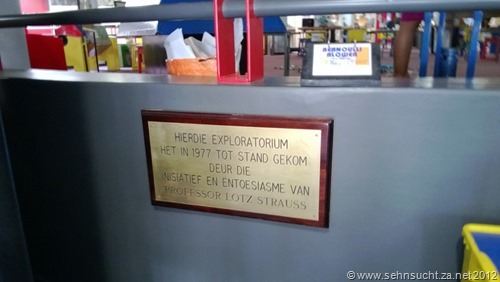
My daughter and I went on a geeky girls’ day out today and visited the Transvaal Natural History Museum as well as the Sci-enza centre at Pretoria University. This is the dedication plaque at Sci-Enza, paying tribute to its father, my role-model/hero and the reason I visited.
6 January 2009
Solar-powered Toyota?
Toyota won't just be adding solar panels to its popular Prius gas-electric hybrid car—like the solar electric conversion kit seen at left—it'll be powering a version of it exclusively via sunshine, according to The Nikkei, Japan's business newspaper. In fact, Toyota will be relying on the solar-electric car to "turn around its struggling business," which resulted in its first operating loss in more than 70 years

Toyota to offer car powered by the sun?: Scientific American Blog
This is a great idea. It would be interesting to see this in production and pitched against the new Honda Clarity, which I am totally impressed with at the moment.
9 November 2008
Nanogenerators: Be your own power plant: Scientific American Blog
As teensy nanotech devices get even tinier, the question of how to supply them with power becomes more pressing. Zhong Lin Wang, a nano-engineer at the Georgia Institute of Technology in Atlanta, is committed to finding the answer. As he described in a January Scientific American article, these devices (measured in nanometers, or billionths of a meter) could rely on nanoscale power plants, which would harvest waste energy from the ambient atmosphere or even from the human body. Now Wang's team has a new addition to the nanogenerator family: zinc oxide wires that produce an alternating current when stretched and released like a rubber band. (Wang is pictured holding a large-scale prototype at the left.)
The new approach, described today in Nature Nanotechnology, has several advantages over earlier techniques, Wang says. For one, it avoids the mechanical scrubbing action that characterized some earlier generators, which means it's less likely to wear down. And the simplicity of the concept lends itself better to mass production. The entire device is covered by a flexible polymer, Wang adds, so it can be embedded in soft materials such as clothing or even muscles, meaning that getting your blood moving by going for a brisk walk or hitting the gym might one day get some electrons moving as well.
Credit: Gary Meek/Georgia Tech
Nanogenerators: Be your own power plant: Scientific American Blog
13 August 2008
Lab makes renewable diesel fuel from E. coli poop - CNN.com
SOUTH SAN FRANCISCO, California -- Fossil fuels that keep our planet running -- oil, natural gas and coal -- were created from the decomposition of plants, plankton and other organic material over millions of years.

Today, scientists all over the globe are working to create fuels with the same properties but without that pesky 100 million-year wait. And "renewable petroleum" is now a reality, on a small scale, in some laboratories.
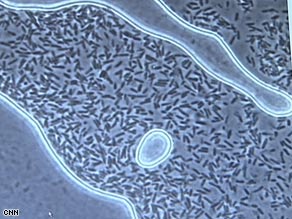
The biotech company LS9 Inc. is using single-celled bacteria to create an oil equivalent. These petroleum "production facilities" are so small, you can see them only under a microscope.
"We started in my garage two years ago, and we're producing barrels today, so things are moving pretty quickly," said biochemist Stephen del Cardayre, LS9 vice president of research and development.
How does it work? A special type of genetically altered bacteria are fed plant material: basically, any type of sugar. They digest it and excrete the equivalent of diesel fuel.
12 August 2008
DailyTech - Commercially Developed Plasma Engine Soon to be Tested in Space
DailyTech has covered advances in the field of rocket propulsion and spaceflight. From such theoretical technologies as a laser engine, to actualized devices like ion drives, there are many unique ideas in the field, despite the relatively tight budgets.
The key challenge facing rocket designers is basic physics. Propulsion is determined by two key factors -- how much stuff you throw out the back of the rocket (mass) and how fast that stuff is going (velocity). One of these factors can be relatively low if the other is high to compensate. Thus on one extreme you have the solid-fuel and liquid fuel rockets -- these exit burning chemicals at relatively low velocities (compared to alternative technologies), but they dump large quantities of mass and therefor produce sufficient thrust. On the other extreme you have technologies such as ion drives, which exit a minuscule amount of mass at much higher speeds, to eventually produce a sufficient impulse.(continued at source)
An artist's rendition of three plasma engines burning in space, propelling a spacecraft, perhaps to Mars. (Source: Ad Astra Space Corporation)
The engine features a three cell design. The first cell creates plasma from hydrogen at 10,000 deg. C. The next cell heats the plasma with radio waves to approximately 100 million deg. C. The last cell is a nozzle which controls how fast this fuel is let out, protecting the spacecraft and allowing acceleration control. (Source: Ad Astra Space Corporation)


Source: DailyTech - Commercially Developed Plasma Engine Soon to be Tested in Space
11 August 2008
BBC NEWS | Science/Nature | Invisibility cloak 'step closer'
Invisibility cloak 'step closer'
For now, the invisibility cloak remains a thing of science fiction
Scientists in the US say they are a step closer to developing materials that could render people invisible.
Researchers at the University of California in Berkeley have developed a material that can bend light around 3D objects making them "disappear".
The materials do not occur naturally but have been created on a nano scale, measured in billionths of a metre.
The team says the principles could one day be scaled up to make invisibility cloaks large enough to hide people.

BBC NEWS | Science/Nature | Invisibility cloak 'step closer'
9 August 2008

Subscribe to:
Posts (Atom)
